Description
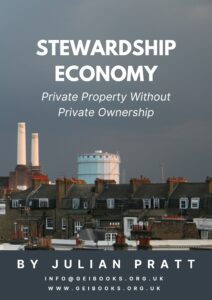
The Stewardship Economy
Private property without private ownership
ISBN 978-1-913354-09-1
This is an absolutely fascinating subject- and some of the most well researched argument we have ever read. We recommend it very highly.
The Stewardship Economy: private property without private ownership provides a new lens through which to view the major economic issues of our time – poverty, inequalities, the environment, globalisation, the tax-benefit system, pensions, house prices, negative equity, banking, recession, unemployment, sovereign debt ….
The lens offered by Julian Pratt is the property system that we apply to the natural world. Markets require an underpinning institutional framework, including property rights and an enforceable law of contract, if they are to function. Our ideas about property are so fundamental to our economy and society that we rarely question them. I don’t question the role of market mechanisms themselves, or the role of the state in regulating the economy and providing public goods. I do, however, question the most fundamental element of the institutional framework: the system of property rights.
The system of property rights with which we are most familiar, ownership, serves us well enough for things that people have produced (artefacts) – chairs, cars, houses and so on. But it serves us poorly when we apply it to the natural world – land and the environment. .
He uses the term ‘ownership economy’ to refer to the sort of economy with which we are familiar, in which the natural world can be owned.
What would it be like to live in a society that does not treat the land and the environment as things that can be owned in the same way as things that people have made?
He is not calling for any change in the ownership of artefacts.
Nor for collective or common property rights to the natural
world. But he is calling for a new form of private property that we can apply to the natural world.
He uses the term ‘stewardship’ to describe a private property system that is similar to ownership, but different in several ways:
The steward of a part of the natural world has o the right of access – to use it in the way that they choose, within the constraints of any relevant regulations o the responsibility of care – to manage it responsibly and husband it for future generations, accepting liability for any damage done to it to the duty of compensation – to pay an annual fee, equal to its market rent, into a fund that is used to benefit everyone o ownership, in the conventional sense, of any buildings or other improvements.
A ‘stewardship economy’ is one in which the natural world is held in stewardship, while artefacts are held in ownership.
In a stewardship economy the income from stewardship fees (for the use of land) may be used to substitute for conventional taxes as a source of revenue for the state; or distributed to the whole population as a Universal Income, an income (which may be age-related) paid to everybody unconditionally without means test or work requirement.
The income from environmental charges is distributed on an equal per capita basis as an Environmental Dividend, or invested for the benefit of future generations.